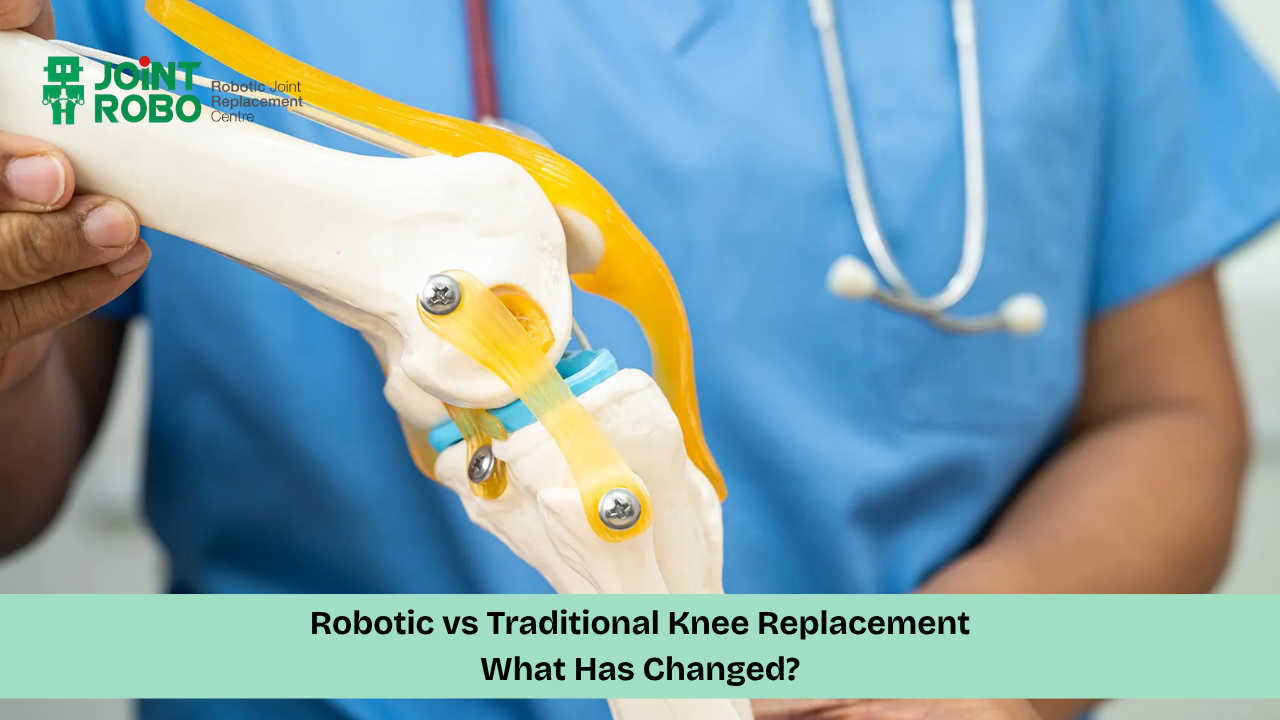
Robotic vs Traditional Knee Replacement: What Has Changed?

Robotic vs Traditional Knee Replacement: What Has Changed?
10 min read

Robotic vs Traditional Knee Replacement: What Has Changed?

Knee replacement surgery has evolved significantly with advances in imaging, surgical planning, and computer-assisted technology. Traditional knee replacement remains an established treatment for severe knee arthritis, while robotic-assisted surgery has introduced additional tools that can help surgeons plan and perform the procedure with greater precision.

This has led many patients to ask an important question: Is robotic knee replacement better than traditional knee replacement?

The answer is not the same for everyone. Both approaches involve replacing damaged portions of the knee joint with artificial components, and the surgeon remains responsible for the procedure. The key difference is the technology used to assist with surgical planning and execution.

For patients exploring robotic knee replacement in Navi Mumbai , understanding these differences can help them have a more informed discussion with their orthopaedic surgeon.

What Is Traditional Knee Replacement?

Traditional or conventional knee replacement is a well-established surgical technique used to treat advanced knee arthritis and other conditions that have severely damaged the joint.

During surgery, the surgeon removes damaged cartilage and a small amount of bone from the affected areas and replaces them with artificial components.

The surgeon uses conventional instruments, cutting guides, measurements, imaging, and clinical judgement to determine the appropriate alignment and positioning of the implants.

Traditional knee replacement has been performed successfully for many years and remains an appropriate treatment option for numerous patients.

What Is Robotic-Assisted Knee Replacement?

Robotic-assisted knee replacement combines the surgeon's expertise with advanced computer-assisted planning and robotic technology.

Depending on the robotic system being used, the process may involve three-dimensional planning before surgery and computer-assisted guidance during the procedure. These tools can help the surgeon assess the patient's anatomy and plan bone preparation and implant positioning.

Importantly, the robot does not independently perform the knee replacement.

The surgeon remains in control of the operation and makes the clinical decisions. The robotic system acts as an advanced surgical assistance tool.

At Joint Robo, robotic-assisted knee replacement is offered in Navi Mumbai with treatment planning based on the patient's individual knee condition and anatomy.

Robotic vs Traditional Knee Replacement: The Key Differences

While the fundamental objective of both procedures is similar, the technology and planning process can differ.

Feature Traditional Knee Replacement Robotic-Assisted Knee Replacement
Surgical planning Conventional imaging and planning Computer-assisted planning may be used
Assessment of anatomy Based on imaging and surgical assessment Detailed digital planning can be used
Surgical instruments Conventional instruments and cutting guides Robotic-assisted instruments and navigation
Implant positioning Guided by conventional techniques Technology can assist with planned positioning
Surgeon involvement Surgeon performs and controls surgery Surgeon performs and controls surgery
Personalised planning Based on individual assessment Digital planning can be tailored to anatomy
Technology Conventional surgical tools Computer-assisted and robotic technology
Suitability Appropriate for many patients Depends on individual condition and surgical plan

The exact technology and workflow can vary depending on the robotic platform and the surgeon's approach.

1. Surgical Planning

One of the major differences is how the surgery can be planned.

With conventional knee replacement, the surgeon uses X-rays, clinical examination, measurements, and established surgical techniques to plan the procedure.

Robotic-assisted procedures may incorporate three-dimensional computer planning, depending on the system being used. This allows the surgeon to assess the patient's anatomy and simulate aspects of the procedure before surgery.

The purpose is to create a surgical plan that takes the patient's individual anatomy into account.

2. Understanding the Patient's Knee Anatomy

Every knee is different.

Patients can have differences in:

  • Bone shape
  • Alignment
  • Joint damage
  • Ligament balance
  • Deformity
  • Previous surgical changes

Robotic-assisted technology can provide additional digital information about the knee during planning and, in some systems, during surgery.

This can be particularly useful when the surgeon needs detailed information about the patient's individual anatomy.

However, technology does not replace the surgeon's clinical assessment.

3. Implant Positioning and Alignment

Correct implant positioning and alignment are important parts of knee replacement surgery.

In conventional surgery, the surgeon uses established instruments, guides, measurements, and experience to position the implants.

In robotic-assisted surgery, the system can provide additional guidance based on the surgical plan. Robotic systems may help the surgeon execute planned bone preparation and implant positioning with greater precision.

This does not mean that robotic surgery automatically produces better results for every patient. The surgeon's experience and the overall treatment plan remain critical.

4. Greater Use of Digital Technology

Traditional knee replacement relies primarily on established surgical instruments and techniques.

Robotic-assisted surgery introduces additional technology into the process.

Depending on the system, this may include:

  • Computer-assisted planning
  • Three-dimensional modelling
  • Digital measurements
  • Real-time navigation
  • Robotic-assisted bone preparation
  • Technology-assisted implant positioning

These tools can give the surgeon additional information during the procedure.

5. Does Robotic Surgery Mean the Robot Performs the Operation?

No.

This is one of the most common misconceptions about robotic knee replacement.

The surgeon remains responsible for:

  • Diagnosing the condition
  • Selecting the appropriate treatment
  • Planning the procedure
  • Making surgical decisions
  • Controlling the robotic system
  • Performing the operation
  • Managing the patient's recovery

The robotic system assists the surgeon rather than replacing them.

This is why choosing an experienced robotic knee surgeon in Navi Mumbai remains an important part of the treatment decision.

What Are the Potential Advantages of Robotic-Assisted Surgery?

Robotic-assisted joint replacement can offer several potential advantages in surgical planning and execution.

These may include:

  • Personalised surgical planning — The procedure can be planned around the patient's individual anatomy using computer-assisted technology.
  • Assistance with alignment — The technology can provide guidance to help the surgeon achieve the planned alignment and positioning.
  • Controlled bone preparation — Robotic systems may help the surgeon precisely follow the planned areas for bone preparation.
  • Real-time information — Some systems provide computer-assisted information during surgery that can help guide the surgeon.
  • Useful for individual anatomical variations — Advanced planning and navigation may be particularly helpful when the patient's anatomy presents specific challenges.

However, these potential advantages should not be interpreted as a guarantee of faster recovery, better implant longevity, or superior results for every patient.

Is Robotic Knee Replacement Better Than Traditional Surgery?

This is where it is important to look beyond marketing claims.

Robotic technology can improve the precision of planning and implant positioning, but robotic assistance does not automatically mean that every patient will have a better clinical outcome.

The American Academy of Orthopaedic Surgeons has reported that available evidence has not established a significant short-term difference in function, outcomes, or complications between robotic-assisted and conventional total knee replacement in its clinical practice guideline.

At the same time, newer research continues to evaluate potential benefits. For example, research presented at the AAOS 2026 Annual Meeting reported higher patient satisfaction and greater improvement in quality of life at one year among patients undergoing robotic-assisted total knee replacement in the study population.

This means the evidence is evolving.

Rather than assuming that robotic surgery is automatically superior, patients should discuss whether the technology offers meaningful advantages for their particular knee condition.

Does Robotic Knee Replacement Mean Faster Recovery?

Not necessarily.

Recovery depends on several factors, including:

  • Overall health
  • Age
  • Muscle strength
  • Severity of arthritis
  • Type of knee replacement
  • Surgical technique
  • Pain management
  • Physiotherapy
  • Rehabilitation
  • Patient participation in recovery

Robotic assistance is primarily a tool for planning and performing the surgery. It should not be presented as a guarantee of a particular recovery timeline.

Your surgeon and physiotherapist can provide a more realistic recovery plan based on your individual circumstances.

Is Robotic Knee Replacement More Precise?

One of the main reasons robotic systems are used is to assist with precision.

The American Academy of Orthopaedic Surgeons explains that robotic-assisted joint replacement combines three-dimensional planning with computer navigation and robotic tools that can assist the surgeon in removing damaged bone and cartilage and positioning artificial components.

However, precision is only one part of a successful knee replacement.

A good outcome also depends on:

  • Correct diagnosis
  • Appropriate patient selection
  • Surgical planning
  • Surgeon experience
  • Implant selection
  • Proper rehabilitation
  • Patient expectations

Technology should therefore complement—not replace—clinical expertise.
Who May Be Suitable for Robotic Knee Replacement?

Robotic-assisted knee replacement may be considered for patients who require knee replacement and are suitable for the technology available at the treating centre.

Your surgeon may evaluate:

  • Severity of arthritis
  • Knee alignment
  • Joint anatomy
  • Bone quality
  • Previous surgeries
  • Range of motion
  • Type of replacement required
  • General health
  • Surgical goals

Not every patient needs robotic assistance, and conventional knee replacement remains an effective treatment option for many people.

The decision should be made after a detailed orthopaedic assessment.

Are There Any Limitations to Robotic-Assisted Knee Replacement?

Like any surgical technology, robotic assistance has limitations.

Depending on the robotic system, patients may require additional imaging before surgery. Some systems may also involve navigation pins, which carry specific risks.

Other considerations can include:

  • Additional technology and equipment
  • Higher treatment costs in some settings
  • Additional pre-operative planning
  • Availability of trained surgical teams
  • Learning curve associated with specific systems

Your surgeon should explain the potential benefits, limitations, risks, and costs before you make a decision.

What About Traditional Knee Replacement?

Traditional knee replacement should not be considered an outdated procedure.

It is an established surgical technique with a long history of use and remains suitable for many patients.

Conventional surgery can provide excellent outcomes when performed by an appropriately trained and experienced surgeon with proper patient selection, planning, surgical technique, and rehabilitation.

The introduction of robotic technology does not make conventional knee replacement unsuitable.

Instead, patients now have access to additional technology that may be appropriate in selected cases.

How Do You Choose Between Robotic and Traditional Knee Replacement?

The decision should not be based solely on whether a hospital offers robotic technology.

Instead, discuss these questions with your surgeon:

  • What is causing my knee pain?
  • How advanced is my arthritis?
  • Do I actually need knee replacement?
  • Would robotic assistance provide a meaningful advantage in my case?
  • Which type of knee replacement is appropriate?
  • What are the expected benefits and limitations?
  • What are the risks of the procedure?
  • What will recovery involve?
  • What will the overall treatment cost?
  • How experienced is the surgical team with the recommended procedure?

A personalised consultation can help you understand which approach makes sense for your condition.

Why the Surgeon Still Matters More Than the Technology

It is easy to focus on the word "robotic" when researching modern knee replacement.

However, technology is only one part of the procedure.

The surgeon still needs to:

  • Diagnose the underlying condition
  • Decide whether surgery is appropriate
  • Select the surgical approach
  • Plan the procedure
  • Assess the patient's anatomy
  • Choose appropriate implants
  • Control the robotic system when used
  • Manage complications if they arise
  • Guide post-operative care

Therefore, when searching for robotic knee replacement in Navi Mumbai , patients should consider the surgeon's experience and treatment approach alongside the technology available.

Why Consider Joint Robo for Robotic Knee Replacement in Navi Mumbai?

Joint Robo focuses on joint replacement care and provides robotic-assisted knee replacement in Navi Mumbai.

The treatment process includes patient assessment, imaging, surgical planning, robotic assistance during the procedure when appropriate, and post-operative rehabilitation.

The emphasis should always be on determining the treatment approach that is appropriate for the individual patient rather than recommending robotic technology simply because it is available.

Frequently Asked Questions

Is robotic knee replacement better than traditional knee replacement?

Robotic-assisted surgery can provide additional planning and surgical guidance, but it is not automatically better for every patient. Evidence regarding clinical outcomes continues to evolve, and the appropriate approach depends on the patient's condition and surgeon's assessment.

Is robotic knee replacement safer?

Both robotic-assisted and conventional knee replacement have potential risks and complications. Robotic assistance does not eliminate surgical risks. Your surgeon should explain the risks and benefits of the recommended approach.

Does the robot perform the knee replacement?

No. The surgeon performs and controls the procedure. The robotic system provides technological assistance during planning and selected aspects of surgery.

Does robotic knee replacement provide faster recovery?

Robotic assistance should not be considered a guarantee of faster recovery. Recovery depends on multiple factors, including the patient's health, surgery, rehabilitation, and adherence to post-operative instructions.

Is traditional knee replacement still effective?

Yes. Conventional knee replacement remains an established treatment option and can provide good outcomes for appropriately selected patients.

Who is a candidate for robotic knee replacement?

Patients who require knee replacement may be considered for a robotic-assisted approach depending on their anatomy, joint damage, surgical requirements, overall health, and the technology available.

How do I choose between robotic and traditional knee replacement?

The decision should be made with an experienced orthopaedic surgeon after reviewing your symptoms, examination findings, imaging, treatment history, and surgical requirements.

The Right Technology Starts With the Right Assessment

Robotic technology has brought new possibilities to knee replacement surgery, particularly in surgical planning, navigation, alignment, and controlled bone preparation. But it is important to remember that technology is a tool—not a substitute for an experienced surgeon.

Traditional knee replacement continues to be an established option, while robotic-assisted surgery may provide additional technological assistance for selected patients.

If you are considering robotic knee replacement in Navi Mumbai , the first step should be a detailed evaluation of your knee rather than choosing a procedure based only on the technology available.

At Joint Robo, an orthopaedic assessment can help you understand the condition of your knee and whether robotic-assisted or conventional knee replacement is more appropriate for your individual needs.

Book a consultation with Joint Robo to discuss your knee condition, treatment options, and whether robotic-assisted knee replacement may be suitable for you.

Disclaimer

This article is intended for general educational purposes only and should not replace professional medical advice, diagnosis, or treatment. The suitability of robotic-assisted or conventional knee replacement varies from patient to patient and should be determined by a qualified orthopaedic surgeon.