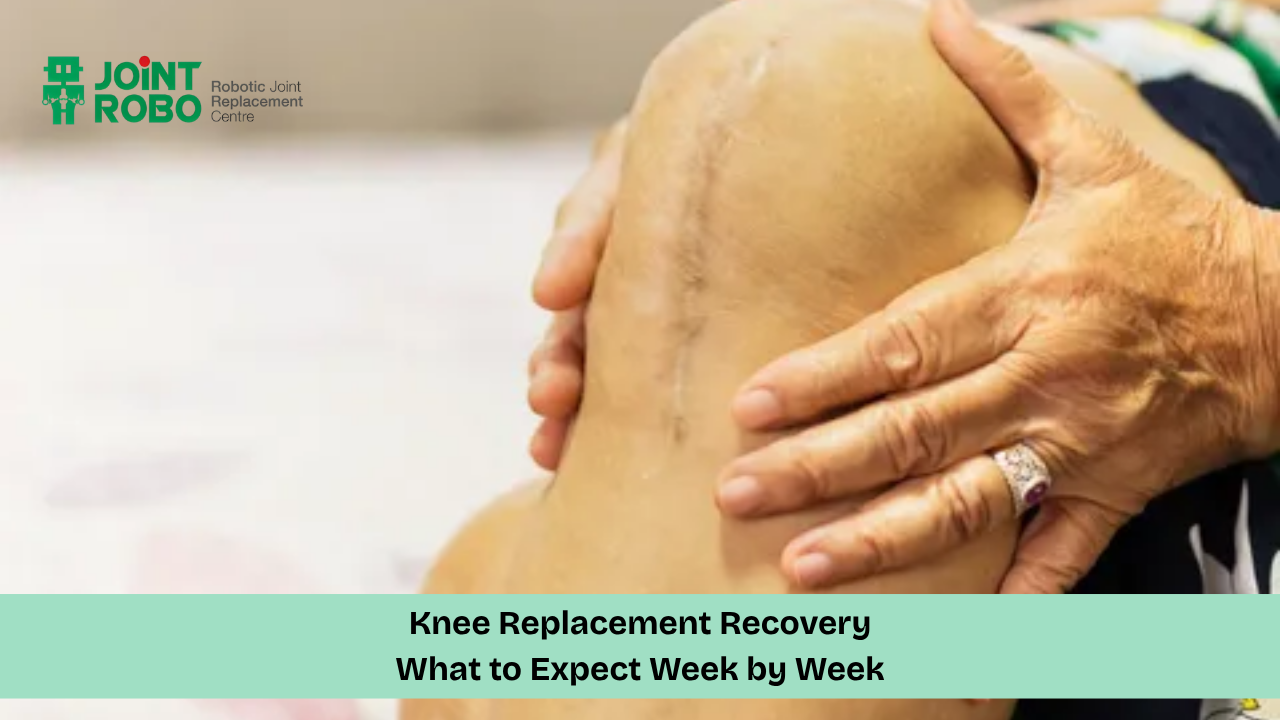
Knee Replacement Recovery: What to Expect Week by Week

Knee Replacement Recovery: What to Expect Week by Week
11 min read

Knee Replacement Recovery: What to Expect Week by Week

Undergoing knee replacement surgery is an important step toward reducing chronic knee pain and improving mobility. But surgery is only one part of the treatment journey. Recovery and rehabilitation play an equally important role in helping you regain movement, strength, and confidence.

Patients considering robotic knee replacement in Navi Mumbai often want to know what recovery will look like after surgery. When will you be able to walk? How soon can you climb stairs? When can you return to normal activities? How long will physiotherapy continue?

While every patient recovers at a different pace, having a general understanding of the recovery process can help you prepare for what lies ahead.

This guide explains what you can generally expect during the first few weeks and months after knee replacement surgery.

What Happens Immediately After Knee Replacement?

The recovery process begins soon after surgery.

Your healthcare team will monitor you as you recover from anaesthesia and will assess your pain, circulation, movement, and overall condition.

Depending on your individual health and surgical plan, you may be encouraged to begin moving the leg relatively soon after surgery.

Early movement is important because prolonged immobility can increase the risk of certain complications and make rehabilitation more difficult.

Your healthcare team may guide you through:

  • Gentle knee movements
  • Ankle exercises
  • Breathing exercises
  • Bed mobility
  • Sitting and standing
  • Walking with appropriate support

The exact approach varies from patient to patient.

Week 1: Getting Comfortable and Starting to Move

The first week is focused on pain management, safe movement, wound care, and beginning rehabilitation.

You may experience:

  • Pain or soreness around the knee
  • Swelling
  • Bruising
  • Stiffness
  • Tiredness
  • Difficulty bending the knee fully

These symptoms can be expected during the early recovery period, although their intensity varies.

Walking During the First Week

Your physiotherapist may help you begin walking with a walker or another appropriate support.

Initially, walking may be limited to short distances.

The goal is not to walk long distances immediately. Instead, the focus is on learning to move safely while gradually increasing activity.

Your physiotherapist may teach you how to:

  • Get out of bed safely
  • Stand up
  • Walk with support
  • Sit down safely
  • Use stairs when appropriate
  • Perform recommended exercises

Follow your healthcare team's instructions rather than trying to progress too quickly.

Managing Swelling and Discomfort

Swelling is common following knee replacement surgery.

Your medical team may recommend measures such as:

  • Elevating the leg
  • Applying cold therapy as instructed
  • Taking prescribed medication
  • Performing recommended exercises
  • Avoiding prolonged periods of standing

Do not apply ice directly to the skin, and follow your healthcare team's specific instructions for managing swelling.

Week 2: Building Confidence With Movement

By the second week, many patients are beginning to become more comfortable with basic movement.

You may still experience swelling and stiffness, particularly after activity.

Your rehabilitation programme may continue to focus on:

  • Knee movement
  • Quadriceps strengthening
  • Straightening the knee
  • Controlled bending
  • Walking
  • Balance
  • Basic daily activities

Your walking distance may gradually increase, depending on your recovery.

Some patients may still need a walker or other support, while others may begin transitioning to a different form of assistance when their physiotherapist considers it safe.

What About Pain?

Pain often changes during recovery.

You may notice that surgical pain gradually decreases, while stiffness or muscle soreness becomes more noticeable after exercise.

This does not necessarily mean that something is wrong.

However, severe or worsening pain should be discussed with your healthcare team.

Weeks 3–4: Improving Mobility and Strength

During weeks three and four, rehabilitation generally becomes more active.

The focus may shift toward improving:

  • Muscle strength
  • Knee flexibility
  • Walking pattern
  • Balance
  • Independence
  • Ability to perform household activities

Your physiotherapist may gradually increase the difficulty of your exercises.

You may also begin walking longer distances as your strength and confidence improve.

Can You Climb Stairs?

Many patients can begin using stairs with guidance relatively early in recovery, but the exact timing depends on strength, balance, pain, and the type of support required.

Your physiotherapist can teach you the safest technique.

Do not assume that because another person was able to climb stairs at a particular time, you should be able to do the same.

Recovery is individual.

Weeks 5–6: Returning to More Everyday Activities

By approximately the fifth or sixth week, many patients are working toward greater independence.

Your rehabilitation may focus on:

  • Improving walking endurance
  • Strengthening the muscles around the knee
  • Increasing range of motion
  • Improving balance
  • Performing daily activities more comfortably

You may be able to walk more comfortably and rely less on walking aids, depending on your progress.

However, you should continue following your surgeon's and physiotherapist's instructions regarding activities.

Can You Drive After Knee Replacement?

The timing of returning to driving depends on several factors, including:

  • Which knee was operated on
  • Your ability to control the vehicle safely
  • Reaction time
  • Pain and stiffness
  • Medication use
  • Your surgeon's advice
  • Local driving requirements

Do not resume driving simply because a certain number of weeks have passed.

You should be able to safely control the vehicle and perform emergency movements before returning to driving.

Weeks 7–8: Increasing Strength and Independence

By this stage, many patients are focusing on returning to a broader range of everyday activities.

You may notice improvements in:

  • Walking
  • Knee movement
  • Muscle strength
  • Balance
  • Confidence
  • Ability to perform household activities

Some swelling may still occur, especially after increased activity.

It is important not to interpret improvement as a reason to suddenly increase your activity level.

Gradual progression is usually more appropriate than doing too much too soon.

Months 3–6: Continuing the Recovery

Knee replacement recovery does not end after six or eight weeks.

Over the following months, you may continue to work on:

  • Strength
  • Flexibility
  • Endurance
  • Balance
  • Walking
  • Functional activities

Many patients gradually return to more normal routines during this period, depending on their individual recovery.

Some residual stiffness or swelling may persist for a while, particularly after demanding activities.

Your surgeon and physiotherapist can help determine when it is appropriate to progress to different activities.

Recovery After Robotic Knee Replacement

Patients considering robotic knee replacement in Navi Mumbai sometimes expect robotic assistance to completely change the recovery process.

It is important to understand that robotic-assisted knee replacement is still a knee replacement procedure.

Robotic technology can assist the surgeon with aspects of planning, alignment, navigation, and controlled bone preparation. However, recovery still depends on factors such as:

  • Your overall health
  • Age
  • Muscle strength
  • Severity of arthritis
  • Surgical procedure
  • Pain management
  • Rehabilitation
  • Activity levels
  • Individual healing response

Robotic assistance should not be considered a guarantee of faster recovery.

The rehabilitation process remains an important part of achieving the best possible functional outcome.

Why Physiotherapy Matters After Knee Replacement

Physiotherapy is a key part of rehabilitation.

Your physiotherapist may design an exercise programme to help improve:

  • Range of motion — Exercises can help you gradually regain the ability to bend and straighten the knee.
  • Muscle strength — Strengthening the quadriceps, hamstrings, calf muscles, and surrounding muscles can support walking and everyday movement.
  • Balance — Balance exercises can help you regain confidence and stability.
  • Walking pattern — Your physiotherapist can help you gradually improve the way you walk and reduce dependence on walking aids when appropriate.
  • Functional movement — Rehabilitation can focus on practical activities such as standing, sitting, stairs, and other everyday movements.

Follow the exercise programme provided by your healthcare team rather than copying exercises from someone else's recovery.

What Can Affect Your Recovery Timeline?

There is no single recovery timeline that applies to every patient.

Your recovery can be influenced by:

  • Age
  • General health
  • Physical fitness
  • Muscle strength before surgery
  • Severity of knee arthritis
  • Type of knee replacement
  • Surgical technique
  • Pain management
  • Physiotherapy
  • Activity levels
  • Commitment to rehabilitation
  • Other medical conditions

This is why two patients who undergo similar procedures may progress at different speeds.

Does Robotic Surgery Guarantee Faster Recovery?

No.

Robotic-assisted surgery may offer technological advantages in planning and surgical precision, but it does not guarantee a faster or easier recovery for every patient.

Your recovery depends on much more than the surgical technology.

A structured rehabilitation plan, appropriate activity progression, pain management, nutrition, rest, and following medical advice all contribute to the recovery process.

Activities to Avoid During Early Recovery

Your healthcare team will tell you which activities should be avoided during your recovery.

Depending on your stage of rehabilitation, you may need to avoid:

  • High-impact exercise
  • Running
  • Jumping
  • Sudden twisting movements
  • Heavy lifting
  • Activities that place excessive stress on the knee

Do not return to sports or demanding physical activities without discussing them with your surgeon or physiotherapist.

How Can You Support Your Recovery at Home?

Your daily habits can make rehabilitation easier.

  • Keep moving safely — Avoid remaining completely inactive for long periods unless your medical team has instructed you otherwise.
  • Follow your exercise programme — Perform your recommended exercises consistently and correctly.
  • Take medications as prescribed — Use prescribed medicines according to your healthcare team's instructions.
  • Maintain a balanced diet — Adequate nutrition supports overall recovery.
  • Get sufficient rest — Your body needs time to recover after surgery.
  • Attend follow-up appointments — Follow-up allows your surgeon to assess your progress and address concerns.
  • Avoid doing too much too soon — Feeling better does not necessarily mean that the knee is ready for unrestricted activity.

When Should You Contact Your Doctor?

Some discomfort, swelling, and stiffness can be expected after knee replacement. However, certain symptoms require prompt medical attention.

Contact your healthcare team if you experience symptoms such as:

  • Increasing or severe pain
  • Significant swelling that is worsening
  • Redness or warmth around the wound that is increasing
  • Fluid or pus from the incision
  • Fever
  • Sudden calf pain or swelling
  • Difficulty breathing
  • Chest pain
  • Sudden loss of movement or function

If you experience severe breathing difficulty, chest pain, or another medical emergency, seek immediate emergency medical care.

What Are Realistic Expectations After Knee Replacement?

Knee replacement is designed to reduce pain and improve function, but recovery takes time.

You should not expect your knee to feel completely normal immediately after surgery.

During recovery, you may experience:

  • Temporary swelling
  • Stiffness
  • Muscle weakness
  • Changes in walking
  • Periods of soreness after exercise
  • Gradual improvement in movement

Progress may not always be perfectly linear. You may have good days and more difficult days during rehabilitation.

The important goal is gradual, sustained improvement.

Why Follow-Up Care Matters

Regular follow-up appointments allow your surgeon to assess your recovery and address any concerns.

Your follow-up may involve evaluating:

  • Wound healing
  • Knee movement
  • Pain
  • Swelling
  • Walking ability
  • Muscle strength
  • Overall function

Your rehabilitation programme can also be adjusted according to your progress.

Choosing the Right Team for Your Knee Replacement Journey

If you are considering robotic knee replacement in Navi Mumbai , it is important to evaluate the complete treatment programme rather than focusing only on the robotic technology.

Consider:

  • The surgeon's qualifications and experience
  • Experience with knee replacement
  • Experience with robotic-assisted procedures
  • Hospital facilities
  • Surgical team
  • Pre-operative assessment
  • Physiotherapy support
  • Post-operative monitoring
  • Follow-up care

A successful recovery involves more than the operation itself. The care you receive before and after surgery is also an important part of the treatment journey.

Frequently Asked Questions

How long does it take to recover from knee replacement?

Recovery varies between patients. Many people gradually regain mobility and independence over the first several weeks, while strength, flexibility, and overall function can continue improving for several months.

When can I walk after knee replacement?

Walking is often started soon after surgery when the healthcare team considers it safe. Initially, you may need a walker or another form of support.

When can I climb stairs after knee replacement?

Stair training may begin relatively early with guidance from a physiotherapist. The timing for using stairs independently depends on your strength, balance, pain, and recovery.

How long will I need physiotherapy?

The duration varies according to your progress and individual requirements. Your physiotherapist will determine how your programme should progress.

Is recovery faster after robotic knee replacement?

Robotic assistance does not guarantee faster recovery. Recovery depends on multiple patient and treatment factors, including rehabilitation and overall health.

When can I return to normal activities?

The timeline varies depending on the activity. Basic daily activities may resume progressively, while higher-impact activities may require more time or may not be recommended.

Can I exercise after knee replacement?

Yes, appropriate exercise is an important part of rehabilitation. However, the type and intensity of exercise should be increased gradually under professional guidance.

Why is my knee still swollen weeks after surgery?

Some swelling can persist during recovery, particularly after increased activity. However, worsening swelling or swelling accompanied by other concerning symptoms should be discussed with your healthcare team.
Recovery Is a Process, Not a Single Milestone

Knee replacement can provide significant relief for patients with advanced joint damage, but the journey does not end when the surgery is completed.

The first few weeks focus on safe movement, pain management, wound care, and starting rehabilitation. Over the following weeks and months, the focus gradually shifts toward improving strength, flexibility, balance, walking ability, and independence.

For patients undergoing or considering robotic knee replacement in Navi Mumbai , robotic-assisted technology can support the surgical planning and procedure, but rehabilitation remains an essential part of recovery.

The best approach is to follow a personalised recovery plan developed by your surgeon and physiotherapy team rather than comparing your progress with someone else's timeline.

If persistent knee pain has been limiting your mobility and you are exploring knee replacement options, an orthopaedic evaluation can help you understand whether conventional or robotic-assisted knee replacement may be appropriate for your condition.

Speak with Joint Robo to discuss your knee condition, treatment options, and what you can expect before and after knee replacement surgery.

Disclaimer

This article is intended for general educational purposes only and should not replace professional medical diagnosis, advice, or treatment. Recovery timelines vary between patients. Always follow the specific instructions provided by your surgeon and rehabilitation team.